
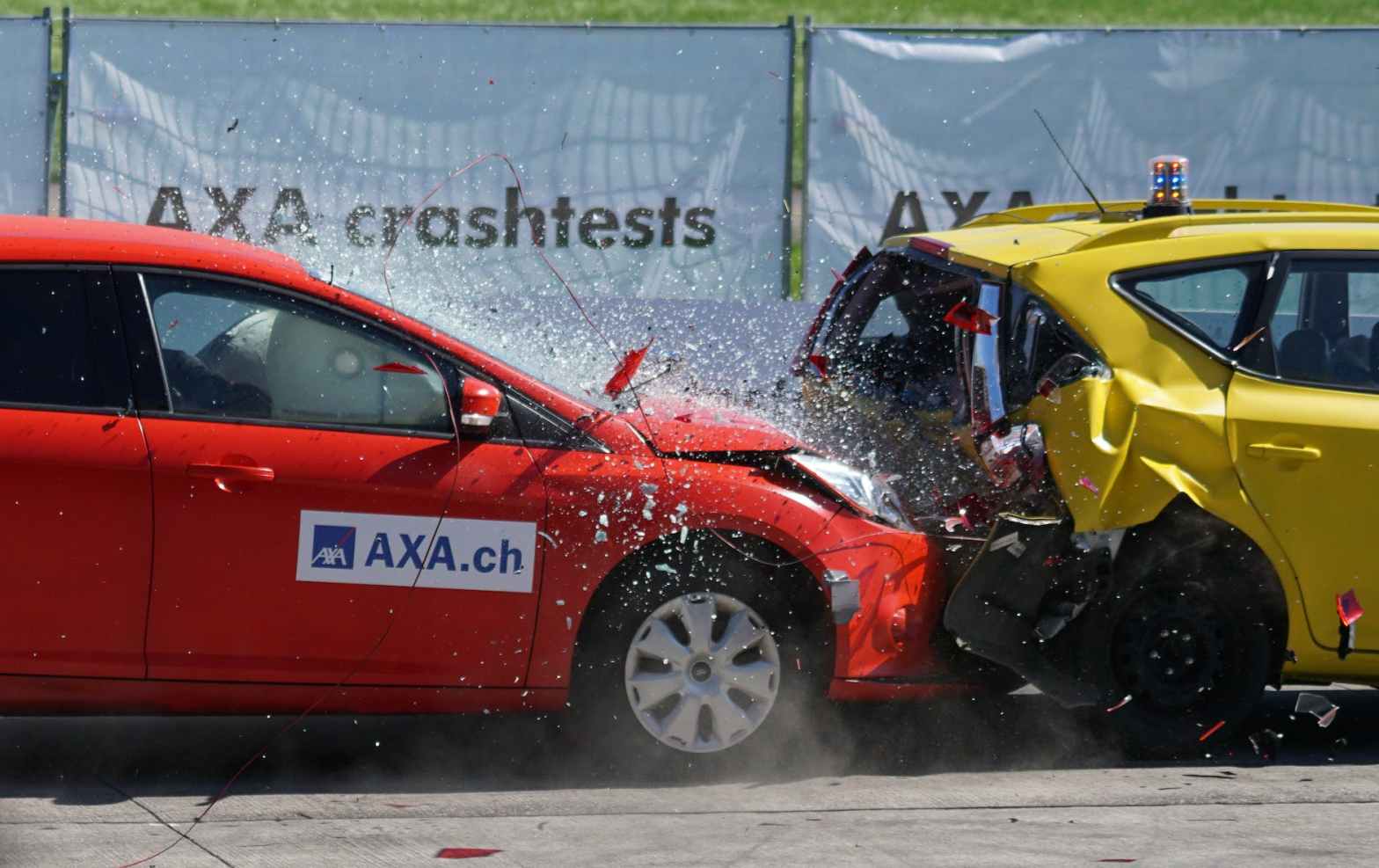
Yes, you. Even if you’ve never been in an accident. Even if you’re smart. Even if you’re me! Because you (and me, and most everyone else) makes bad decisions on a regular basis. And maybe it’s just me, but I can’t consider someone to be a good driver if they’re consistently making bad driving decisions.
In particular, there’s one bad decision I see almost everyone make at least some of the time, and many probably don’t even realize they’re making it:
Tailgating
And guess what? It’s dangerous!
Most people probably have a fairly narrow definition of tailgating. Maybe it only “counts” if you’re within 5 or 10 feet of someone. But the truth is, if you’re close enough to the car ahead that you would crash into them if they stopped suddenly, you are functionally tailgating. You’re just lucky that they don’t stop suddenly very often.
But when they do stop? Hoo boy, well now you’ve got yourself a rear-end collision, the most common type of car crash in the U.S.[1] (excluding crashes with non-vehicles). Luckily for you, this most-common crash is also probably one of the easiest to prevent. I’ll let you in a secret insider tip:
✨ Just slow down for like 3 seconds ✨
Yes, that’s right, just lay off the gas pedal for a few seconds until you have some extra space between you and the car ahead of you. Then you can go back to your normal speed. Yes, you may arrive at your destination approximately 3 seconds later. Yes, this is worth it.
Just remember: the faster you’re going, the more space you need. You also need to add extra space if it’s dark or rainy, since it’s harder to see ahead and anticipate a stop. Usually it’s easier to measure the distance in seconds rather than feet, where a “second” of distance means that if the car ahead of you were to suddenly stop, and you kept going the same speed, then you would hit them in one second. A “second” automatically adjusts its distance (in feet) based on your current speed, and it’s easier to measure, too! All you have to do is look at a reference point on the road (such as a lane marking, street lamp, or sign), and start counting “Mississippis” once the car ahead of you passes it. Stop counting once you pass it. The number of seconds you counted is the number of seconds away you are!
Ideally, you want at least 2-4 “seconds” of space in front of you. This should allow you have plenty of time to react to sudden braking.
You may think that that seems excessive. After all, the average reaction time of a human is about a quarter of a second, so that should be all that you need, right? But consider this: when you see brake lights ahead of you, you don’t actually know if they are 100% slamming on their brakes. In 99.9% of cases, they aren’t! Maybe they’re just tapping the brake lightly. It would be an overreaction for you to slam on your brakes 100% every time you saw brake lights ahead. So in that 0.1% case where the person ahead slams their brakes, even if you start braking quickly after that, you probably aren’t braking as hard as they are. And that means that you can still crash into them!
And this doesn’t even take into account other factors. What about the fact that cars brake at different rates? Your car might brake slower if you are carrying a heavy load, or if your brakes are more worn out than theirs. Or maybe you’re distracted, or even just looking at something else at the very moment the person ahead begins braking. Or heck, maybe the sudden braking started 3 cars ahead of you, and the person directly ahead crashed into them. Good luck slowing down in time when the car ahead of you is suddenly at a dead stop!
Now with that out of the way, let’s handle some frequently asked questions.
FAQ
But what if I can see that there’s no reason for the car ahead to stop suddenly?
Maybe you can see ahead, and maybe you will be safe. But what if you can’t, even if just for a second? The car ahead is probably going to be at least partially obscuring the road. Maybe there’s debris that’s hard to see, and the other driver doesn’t notice until it’s too late. Maybe a deer jumps out at the last second. Maybe something actually falls off of the back of the car and you need time and space to avoid it. Is there really any reason to risk it?
But if I leave space ahead of me on a freeway, won’t people just change lanes to be in front of me?
Yes. And that’s fine. If someone else squeezes in, then just make a little more room again. It’s better to arrive at your destination a few seconds later if it means you get there in one piece.
Plus, you’ll be doing a public service to the folks around you, since you’ll be making it easier to change lanes!
What if me slowing down makes the person behind tailgate me in response?
Someone who’s tailgating you is probably likely to tailgate you regardless of what you’re doing. But even if they do start tailgating you even more, that risk is probably balanced out by your reduced risk of hitting the person in front of you. So when you have a tailgater, you’re no worse off, and when you don’t, you’re safer! There’s no reason not to give some breathing room. The person ahead may appreciate it too.
Oh yeah, and the tailgater will probably just pass you soon enough anyway. In fact, you should consider slowing down a bit during passing zones to help encourage them to do so. Not dangerously slow. Not brake-checking. Just slightly below the speed limit.
But none of this stops people from rear-ending me!
That’s not a question, and it’s not fully true either! While it’s true that you can’t completely prevent some bozo from crashing into your back bumper, driving defensively will still reduce your risk. How? Well, if you have extra space in front of you, then that means that you don’t have to brake as quickly in the event of an emergency, which means that you are giving the person behind you more time to react to the situation. They probably aren’t expecting people to ever 100% slam on their brakes, so if you do, then they might not realize it, and so they might not brake hard enough (or fast enough) to prevent a crash. But if you have enough space to brake softly and come to a gentle stop, then everything is fine!
Oh, and if you do still get in a crash, at least the law and insurance companies will likely be on your side if you were the one who got rear-ended.
Conclusion
It’s easy to become complacent when you drive regularly for years and never get in a crash. But it’s always important to remember how incredibly dangerous driving is, and how even the smallest mistake can be life-ending. We all fall into “auto-pilot mode” sometimes, even me, but I challenge you to try and remember this article and start counting seconds between you and the car ahead. Once you get a feel f0r it, it will start to become natural, and hopefully you can enjoy many crash-free years of driving to come.
[1] Rear-end crashes are the most common type of collision between motor vehicles according to the NHTSA, “Table 29: Crashes, by First Harmful Event, Manner of Collision, and Crash Severity, 2020” at https://cdan.nhtsa.gov/tsftables/tsfar.htm# . Note that collisions between a vehicle and a non-vehicle are more common than rear-end crashes.
 The Readyist
One thought on “You’re Probably a Bad Driver”